The Supermoon Eclipse — before the clouds eclipsed …

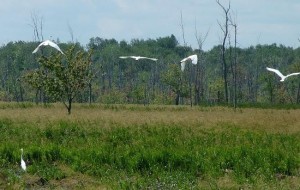
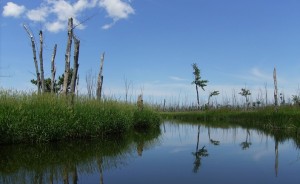
Four of us turned out at Island Lake to hope for clear skies — and we were in luck! Clouds covered the moonrise to the east, but the cloud-free western skies for sunset gave us hope. In the meantime, 5 cormorants flew to roost nearby in a remarkably flimsy dead tree, swaying in the light breezes. Muskrats dove in front of us, surfacing with winter vegetative clumps on which they munched while lying on the surface. At least three Killdeer called repetitively amongst themselves. Two Great Blue Herons foraged successfully in the shallows right beside us long into darkness.

image


The clouds stayed off low along the horizon to the east as the Moon rose above them. Shafts of high thin altocumulus rose westwards out of the bank of clouds. These shafts of cloud alternately covered and uncovered the eclipsing Moon, providing some gorgeous opportunities for photos. My trusty smartphone was pushed to its limits in this low light, but this next photo at least partly captures the atmosphere.

Streaks of clouds lit by the eclipsing Moon at Island Lake

Streaks of clouds lit by the eclipsing Moon at Island Lake (photo by Mark Whitcombe)

A surprising number of people were still out, even at 10 P.M. when the clouds finally eclipsed the slightly-over-half eclipsed Moon. So we saw the reddening as the cloud entered the umbral shadow of the Earth beginning at 9:11 P.M.  But we didn’t see the full eclipse. The clouds ultimately won …

The clouds won the eclipse show …

The clouds won the eclipse show …  (photo by Mark Whitcombe)

When I asked at the UCFNC meeting the next Tuesday, about 20 people put up their hands to say that they had seen at least some part of this impressive natural event, almost all directly from their homes. Nice!

(by Mark Whitcombe)


Supermoon Eclipse this Sunday September 27th!

There is a special eclipse of the Moon Sunday evening, and despite the forecast of some cloud during the early evening hours, and the possibility of rain overnight, I’m going to head out to see it! Perhaps it will be cloudy, perhaps there may even be some showers, but I’m hopeful that there’s going to be either light enough cloud to see something worthwhile, or that there may actually be a break in the clouds during the critical hours just after dark as some weather models show.

You are invited to join me. I’m going to park at Home Hardware and walk across Highway #10 at the lights. Once across the road, I go through the ‘gates’ and turn left along the new path that heads northwards parallel to the highway. I’m going to go close to the end of the first long bridge, which is about half a kilometre of easy flat walking.

Sunset is at 7:09 pm local time, and the full moon will rise at 7:01 pm and we’ll be looking at it across the lake — which should be quite lovely. As you can see from the attached graphic, at 9:07 pm, the Moon will begin to be eclipsed by the umbra of the Earth (the darkest part of the Earth’s shadow. This will likely be the first time that noticeable changes to the Moon will occur. Perigee, the closest approach of the Moon to the Earth, is at 9:46 pm. The Moon is full, i.e., in direct opposition to the Sun, at 10:50 pm, and totality will begin ending at 11:23 pm, with all visible changes likely gone by 12:27 am on Monday morning.

SupermoonEclipse

Fred Espinak’s excellent graphic of the Supermoon Eclipse

I’m aiming to be out at the lake by about 7:00 pm, warmly enough dressed and with a lawn chair, binoculars, camera, tripod, and several flashlights. I’ll stay until conditions are too poor to see anything — or until the eclipse is over … You are welcome to come any time, and to leave any time. You will be responsible for getting yourself to where I’ll be viewing the eclipse. I’ll not be waiting anywhere other than at my chosen viewing position. The peak time will be from 9 pm to midnight. Perhaps you might poke your head out the door several times as the evening progresses, and make your decisions to whether to wander out and join me!

A Naturalist in the Maritimes

      No Comments on A Naturalist in the Maritimes

It’s a large world; it’s a small world; it’s a diverse world; it’s a connected world.

We’re a third of our way through our tour of the eastern provinces, presently staying in Nova Scotia with friends from university and before.
Turns out that “D” was the statistics advisor to Troy Macmillan, whom you might remember as our lichen speaker and field trip guide from several years back. It’s a small interwoven world!

image
We’re staying with “D&L” at their cottage on a lake in the interior of Nova Scotia. We could be on any Algonquin area lake, with rich brown humus-y water, Common Loons, Lake Trout, Ospreys and Poison Ivy. But something is subtly and significantly different. Red Maples predominate, not Sugar Maples which are rare. There’s Grey Birch as well as the more familiar Silver and Yellow species. The American Beechs almost all have fungal infection that makes their mature bark look more like a maple than the elephant’s leg we admire. There’s copious shaggy wisps of Usnea lichen on the trees. It’s a diverse world. (And we’ve not really been on the sea coast yet!)

Cantharellus minor (?), small red chanterelle

Cantharellus minor (?), small red chanterelle

I’m struck by the rich palette of paints used on the wooden house sidings. (“L” has a fondness for Maud Lewis!) Nothing to do with natural history, you say! However … perhaps there’s a relationship between damp maritime climates, available housing materials and skills, and a human desire for colour … It’s a connected world.

Passing through the well-treed city of Fredricton — gorgeous American Elms! — we stopped to see the chimney where an estimated 200 Chimney Swifts rooster earlier this year.


Fredricton Chimney Swift roost — 200+this year!

Fredricton Chimney Swift roost — 200+this year!

The slow-moving line of heavy storms we pierced as we left Orangeville hammered us in Arnprior that night, blasted us in Québec City a couple of days later, and then blinded us as we drove at night down the Saint John River valley in New Brunswick. That same line of heavy weather passed back and forth above us for more than a week! It’s a small inter-connected world.

Thunderstorm over the upper Saint John River Valley

Thunderstorm over the upper Saint John River Valley

A Bald Eagle, an adult with a magnificent white tail, just glided over me as I write this. It’s a magnificent world. And seeing all of this through a naturalist’s ‘eye’ is wondrous!

Watching Saturn & waiting for Tiangong, the Chinese space station

Watching Saturn & waiting for Tiangong, the Chinese space station